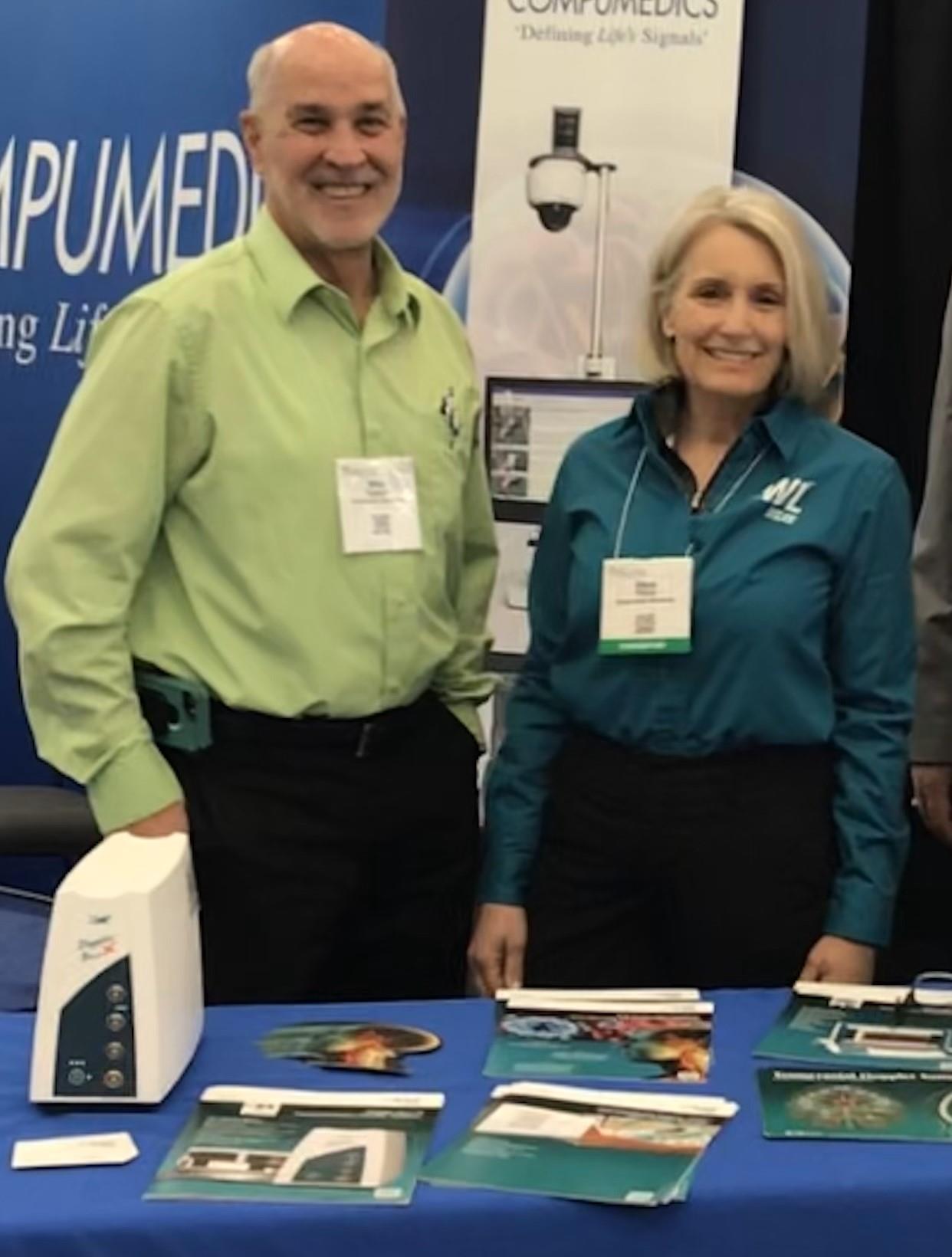
 Mike Coppola and Alene Pichly told us about the Transcranial Doppler (TCD) product made by Compumedics DWL / DWL USA, Inc.
 The Transcranial Doppler (TCD) was invented in the 1950's and use became widespread in the '80's. It is a non-invasive way to measure blood flow to the brain. It can diagnose a variety of conditions, including 1) Acute ischemic stroke; 2) Vasospasm; 3) Cerbral microemboli, aka a TIA or Transient ischemic Attack; and 4) when a baseline is available, a concussion. Mike believes that a TCD should be used at sporting events in every high school and college to more conclusively determine whether an athlete has suffered a concussion. TCD can also diagnose a PFO, aka Patent Foramen Ovale, which is a hole in the wall between the two upper chambers of the heart -- surprisingly, one in four Americans have this condition.
Mike conducted a demonstration using Alene as his patient. Mike used some lubricant and placed the probe of the TCD near Alene's temple. Mike only needed two weeks of training to be able to use the device. We were able to see a visualization of the blood flow through Alene's Medial Cerebral Artery (MCA). The blood velocity and other factors looked good for Alene with no emboli present.
Neither Marshall Hospital nor Kaiser Roseville has one of these machines. UC Davis in Sacramento does. They cost between $10K and $50K. Even though an MRI can diagnose many of the same conditions, the MRI machine is far more costly, and it takes longer to schedule a patient and run them through the MRI. Mike believes that resistance to purchasing a TCD is lack of education, even among the younger doctors.
Mike and our Dr. Cheryl Matossian had a productive discussion about the usefulness of one of these machines to detect concussions quickly at a football game. After the meeting, Mike offered to do free TCD sessions with members. Quickly, there was quite a line of members waiting to check out the flow of blood to their brain.